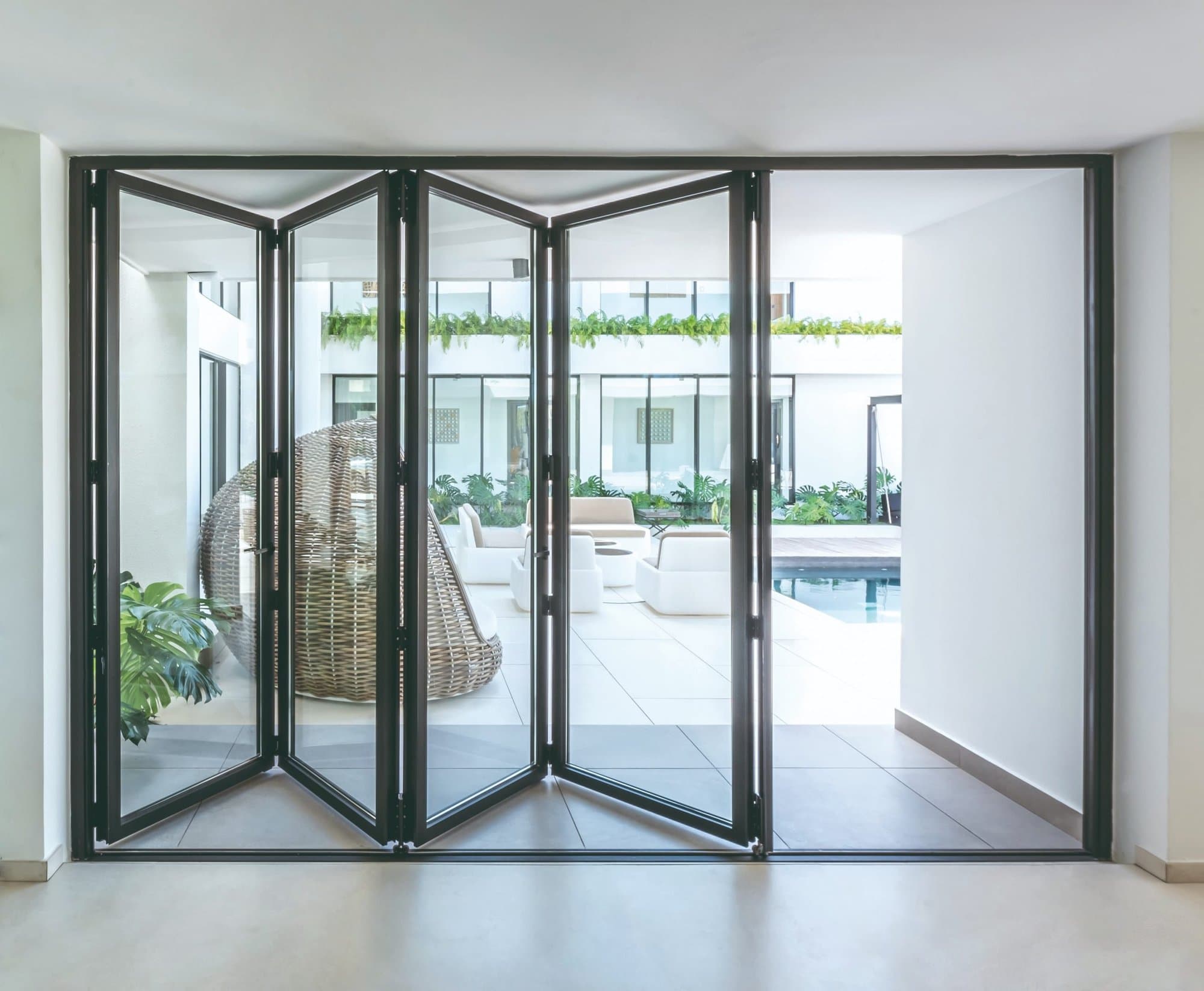
Cortizo and Schüco are two of the aluminium system brands you'll meet when you price bifold doors in the UK. Both are system companies: they design and test the aluminium profiles, and independent fabricators make the doors. So comparing them means comparing the systems, using the figures each brand publishes, and then thinking about who will make your door.
This guide is for homeowners planning an extension or renovation, and for the builders, installers and architects who specify bifolds for them. We should say upfront that Mazuli fabricates Cortizo bifold doors at our factory in Leeds, and Cortizo is the system we recommend. Every Schüco figure below comes from Schüco's own UK website, for its AS FD 75 and AS FD 90.HI folding sliding systems. Where a figure isn't published, or the two brands measure it differently, we say so.
The short version
- Cortizo Bifold panels go up to 1,200mm wide, 3,000mm tall and 120kg, in 2 to 7 panels. Schüco's AS FD vents go up to 1,500mm wide and 150kg, and up to 3,000mm tall (AS FD 75) or 3,500mm (AS FD 90.HI), in 1 to 7 vents.
- Cortizo bifolds are from 1.5 W/m²K double glazed with Ug 1.0 glass and 1.1 W/m²K triple glazed. Schüco gives a Uw from 1.1 W/m²K for AS FD 75 and from 0.8 W/m²K for AS FD 90.HI, without the glass stated.
- Both publish air permeability Class 4 and PAS 24. Cortizo publishes water Class 9A and wind Class A3; Schüco publishes watertightness E 750, wind Class C3 and B5, and burglar resistance up to RC 2.
- Cortizo is our pick for most UK homes, and we make Cortizo bifolds, so weigh our view with that in mind. Schüco suits openings that need wider, taller or heavier panels, or a deeper, more insulated profile.
How are Cortizo and Schüco bifolds made and sold?
Both brands work the same way, which makes this a cleaner comparison than most.
Two system companies
A system company designs and extrudes the aluminium profiles, develops the hardware that goes with them and puts the system through testing. It doesn't usually sell finished doors to homeowners. Fabricators buy the profiles, then cut, machine and assemble each door to order.
Schüco describes itself as a group based in Bielefeld that develops and sells system solutions in aluminium, steel and PVC-U for the building envelope. Its AS FD platform, which it calls a folding sliding system, is its current bifold. It comes in two depths: AS FD 75 and AS FD 90.HI.
Cortizo works the same way. We buy Cortizo profile and fabricate Cortizo bifold doors in-house at our 25,000 sq ft factory in Leeds, then supply them glazed or unglazed to trade and retail customers across the UK mainland.
What that means for you
With either brand, the system sets the limits and the test results, but the fabricator decides how well the door is made, what glass goes in it, how long it takes and how it reaches you. Two doors on the same system can differ on all of those. So ask two questions of any quote: which system is it, and who makes it?
How do Cortizo and Schüco bifolds compare?
Here are the two side by side on the points that decide how a bifold looks and performs. Cortizo figures are for the Cortizo Bifold system as we make it. Schüco figures come from the technical information Schüco publishes for each AS FD system on its UK website.
Panel sizes and weights
Our Cortizo Bifold panels go up to 1,200mm wide, 3,000mm tall and 120kg. We make them in 2 to 7 panels, so the widest single set is about 8,400mm. A 3-panel door, up to 3,600mm wide, is the most common size for a rear extension.
Schüco publishes larger limits for AS FD:
- Vent width: 500mm to 1,500mm on AS FD 75, and 600mm to 1,500mm on AS FD 90.HI.
- Vent height: 660mm to 3,000mm on AS FD 75, and 660mm to 3,500mm on AS FD 90.HI.
- Vent weight: up to 150kg on both.
- Number of vents: 1 to 7, with a maximum unit width of 10,500mm on both.
Maximum width, height and weight rarely all apply at once. A panel at full width and full height in heavy glass can go over the weight limit, so check the actual panel you need with the supplier, whichever system you choose.
For most UK homes, panels of up to 1,200mm by 3,000mm cover the opening comfortably. If you want fewer, wider panels across a big opening, or a door taller than 3,000mm, the AS FD figures go further.
Frame depth and glass
The Cortizo Bifold has a 73mm frame depth, with a 1.8mm profile wall in 6063 T5 aluminium alloy.
Schüco names its two AS FD systems after their depth: 75mm for AS FD 75 and 90mm for AS FD 90.HI. AS FD 75 takes glass from 8mm to 50mm thick, and AS FD 90.HI from 23mm to 65mm. The deeper profile takes thicker glass and has the lower published U-value.
U-values and Part L
In England, Approved Document L, Volume 1 (2021 edition incorporating 2023 amendments) sets the limit for new or replacement doors in an existing home, extensions included. Table 4.2 gives a maximum U-value of 1.4 W/m²K, or a Doorset Energy Rating of Band C for doors with more than 60% of the internal face glazed. What counts is the whole-door figure, frame included, not the centre-pane glass figure.
- Cortizo Bifold: from 1.5 W/m²K double glazed (Ug 1.0) and 1.1 W/m²K triple glazed. If your building control body wants 1.4 W/m²K, specify triple glazing, or use the Doorset Energy Rating route for a door more than 60% glazed.
- Schüco AS FD 75: a Uw from 1.1 W/m²K, with a frame-only Uf from 2.15 W/m²K.
- Schüco AS FD 90.HI: a Uw from 0.8 W/m²K, with a frame-only Uf from 1.3 W/m²K.
Schüco's figures are "from" values, and its pages don't state the glass behind them. A lowest-case Uw with unstated glass can't be compared fairly with a figure for named double or triple glazing. Whole-door U-values also change with the size of the door. Ask each supplier for a figure calculated for your size and your glass, in writing, before you compare.
Weather testing
The Cortizo Bifold system has been tested to European standards, on a 2,700mm by 2,530mm three-panel sample:
- Air permeability Class 4 (EN 12207)
- Water tightness Class 9A (EN 12208), watertight to 600 Pa
- Wind resistance Class A3 (EN 12210), tested at 1,200 Pa
Schüco publishes air permeability Class 4, watertightness E 750, wind load resistance Class C3 and B5, and four drainage levels for both AS FD systems. Its pages don't say what size of sample was tested. Test results depend on the sample size and configuration, so on an exposed site, such as a coastal or hilltop home, ask for the test report for a door close to yours.
Security
The Cortizo bifold system has passed PAS 24 testing, the usual UK security benchmark for doorsets. Our Cortizo bifolds come with multi-point locking, shoot bolts on the intermediate panels, anti-lift blocks and internally beaded glazing as standard, and a 3-star anti-snap cylinder upgrade is available.
Schüco lists burglar resistance "up to RC 2, PAS 24" for both AS FD systems, and says they can take security glazing. Ask for the report for the exact door and locking you're buying.
Thresholds and opening options
- Cortizo: a standard 55mm threshold, a low 20mm threshold, or low with a rebate at 40mm overall. Cills from 90mm to 230mm. Doors can open in or out, fold direction is set panel by panel, and a traffic door can be added to any configuration.
- Schüco AS FD: three threshold heights (under 12.5mm, under 20mm and over 20mm), including a flat threshold. Schüco says the system can fold inwards or outwards, to the left or right, and offers an optional side-hung door for everyday access.
A flat or very low threshold does less to hold back driving rain than one with an upstand. Whichever system you choose, agree the inside and outside floor levels and the drainage before the doors are ordered.
Sightlines
Schüco gives a face width of 90mm where vents interlock, 41mm for the vent frame and 71mm for the outer frame, and a meeting stile face width from 142mm (AS FD 75) or 138mm (AS FD 90.HI). Brands measure the visible frame in different places, so a figure from one rarely lines up with another's. Ask each supplier for a section drawing and compare the width of frame where two panels meet.
Cortizo and Schüco side by side
"Not published" means we couldn't find the figure on Schüco's UK pages, not that the system fails it.
| Cortizo Bifold (made by Mazuli) | Schüco AS FD 75 | Schüco AS FD 90.HI | |
|---|---|---|---|
| Frame depth | 73mm | 75mm | 90mm |
| Maximum panel | 1,200 × 3,000mm, 120kg | 1,500 × 3,000mm, 150kg | 1,500 × 3,500mm, 150kg |
| Panel count | 2 to 7 (up to about 8,400mm) | 1 to 7 (up to 10,500mm) | 1 to 7 (up to 10,500mm) |
| Whole-door U-value (W/m²K) | From 1.5 double glazed (Ug 1.0); 1.1 triple glazed | Uw from 1.1; glass not stated | Uw from 0.8; glass not stated |
| Air / water / wind | Class 4 / Class 9A / Class A3 | Class 4 / E 750 / C3 and B5 | Class 4 / E 750 / C3 and B5 |
| Security | System has passed PAS 24 testing | Up to RC 2, PAS 24 | Up to RC 2, PAS 24 |
| Thresholds | 55mm, 20mm, or 40mm with rebate | Under 12.5mm, under 20mm, over 20mm | Under 12.5mm, under 20mm, over 20mm |
| Everyday access | Traffic door on any configuration | Optional side-hung door | Optional side-hung door |
| Opening | In or out | In or out | In or out |
For a wider view, our guide to aluminium bifold door systems compared puts Cortizo and Schüco alongside Origin, Smart Systems, AluK and Reynaers, and our Cortizo vs Origin comparison covers the most-asked-about alternative.
What affects the price of a Cortizo or Schüco bifold?
We don't publish other brands' prices, and the price of any system bifold is set by the fabricator who makes it, not by the system brand alone. These are the things that move the price of a bifold on either system:
- Panel count and size. Each panel adds profile, hardware and glass. Taller and wider panels need more of all three.
- Profile depth. A deeper, more insulated profile uses more material than a slimmer one.
- Glass. Triple glazing, solar control, acoustic and laminated security glass all cost more than standard double glazing, and thicker units need a system that can take them.
- Colour and finish. Stock colours usually cost least and are quickest. RAL, dual-colour and woodgrain finishes add cost and time.
- Thresholds, cills and add-ons. Low thresholds, traffic or side-hung doors, cills, Georgian bars, trickle vents and integral blinds all appear on the quote.
- Who makes it and how it's supplied. Fabricators price differently, and glazed or unglazed supply, delivery and VAT change the total.
When you compare quotes, check that each includes the same glass, cills, add-ons, delivery and VAT. Our guide to what aluminium bifold doors cost gives our supply-only guide prices for Cortizo bifolds.
How long do they take, and who fits them?
Lead time depends on the fabricator
With any system brand, the lead time is set by the fabricator. Most UK aluminium fabricators quote 3 to 6 weeks. We make Cortizo bifolds in-house in Leeds and deliver on our own fleet, so ours are shorter:
- Unglazed, stock colour: 2 to 5 working days
- Glazed, stock colour: 6 to 10 working days
- RAL colours: around 2 weeks
- Woodgrain finishes: 4 to 6 weeks
You get a delivery date when you order, and mainland UK delivery is included. Whichever system you choose, ask for a lead time and delivery date in writing before you book your installer. Our guide to aluminium door lead times explains what sits behind those numbers.
Glazed or unglazed
We never deliver doors with the glass fitted. Either way, the frames arrive fully assembled with their hardware and locking, and your installer fits the glass on site. A glazed order includes sealed glass units made to size by our glass supplier, delivered with the frames. An unglazed order is the frames only, and your installer sources the glass. Unglazed is our fastest route, which is why many trade customers choose it.
Who fits the doors
We supply and deliver. We don't install, so you or your installer confirm the sizes and fit the doors. Retail customers use their own builder or installer, who also handles Building Regulations sign-off.
Why do we recommend Cortizo?
We chose Cortizo to build our business on, so we aren't neutral. These are the reasons we'd give a customer, and each one is a published figure you can check:
- Tested security. The Cortizo bifold system has passed PAS 24 testing, and our bifolds come with multi-point locking, shoot bolts, anti-lift blocks and internally beaded glazing as standard.
- Published weather classes. Air permeability Class 4, water tightness Class 9A and wind resistance Class A3, from a stated test sample.
- Panels that suit most UK homes. Up to 1,200mm wide and 3,000mm tall, in up to 7 panels, for openings up to about 8,400mm.
- U-values with the glass stated. From 1.5 W/m²K double glazed with Ug 1.0 and 1.1 W/m²K triple glazed, so you know what to specify for Part L.
- A durable finish. Cortizo's QUALICOAT-certified powder coating, which we guarantee for 10 years against discolouration, flaking and UV fading.
- A short, direct route. We make Cortizo bifolds to order in Leeds, in 2 to 5 working days unglazed and 6 to 10 glazed in stock colours, and deliver them on our own fleet. Trade and retail customers buy from us directly.
None of that makes Schüco a poor choice. Its AS FD systems publish strengths of their own, and the right door depends on the project.
Which suits which project?
- Cortizo: our pick for most UK homes and extensions, where panels up to 1,200mm by 3,000mm cover the opening and you want published air, water and wind classes, PAS 24 testing, a clear route to Part L with the glass stated, and a short lead time from a UK fabricator you can buy from directly.
- Schüco AS FD 75: consider it if you want fewer, wider panels of up to 1,500mm, a flat threshold, or a project that calls for an RC 2 burglar resistance class.
- Schüco AS FD 90.HI: consider it for doors taller than 3,000mm (up to 3,500mm), glass units thicker than 50mm, or a project where the specifier wants a deeper 90mm profile with a published Uw from 0.8 W/m²K.
Whichever you choose, get the whole-door U-value for your size and glass in writing, check the test reports, and agree the threshold and floor levels before you order. Our complete guide to aluminium bifold doors covers sizing, Part L and preparing the opening in more detail.
Mazuli Cortizo bifold doors
Mazuli is a fully accredited Cortizo manufacturer and one of the largest Cortizo-certified manufacturers in the UK. We fabricate Cortizo bifold doors in Leeds in 2 to 7 panels, in seven stock colours, any RAL colour and woodgrain finishes, and supply them glazed or unglazed to installers, builders and homeowners across the UK mainland. Factory visits are welcome by appointment, Monday to Friday.
See specifications and colours on our aluminium bifold doors page, or request a quote. Installers and builders can open a trade account with no minimum order value. You can also call 0113 827 5596 or email sales@mazuli.co.uk.